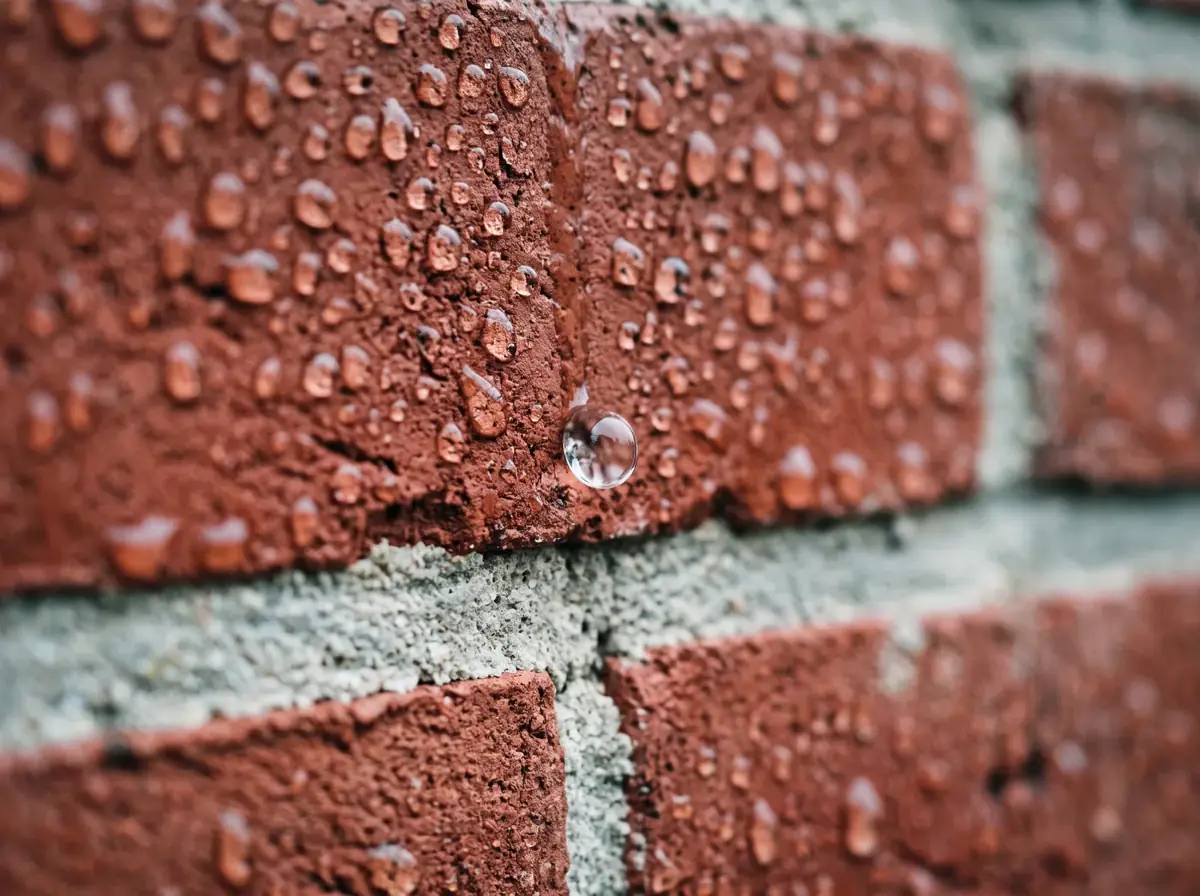
A brick facade that darkens with every shower, an internal wall that marks in winter, saltpetre at the foot of a partition: three similar symptoms, three different causes. Treating the wrong one costs money and fixes nothing.
Telling the three cases apart
Water coming in through the facade is recognisable by its rhythm: it shows up after driving rain, usually from the west, then dries out. It marks high up as much as low down, and follows the most exposed areas.
Rising damp, on the other hand, never climbs more than a metre to 1.20 m above ground level, is there all year round and leaves white saltpetre deposits. A water-repellent facade treatment will change nothing: what it needs is an injected damp-proof barrier.
Condensation, finally, shows up in cold corners and behind furniture, in winter, in rooms that are barely ventilated. That is a ventilation matter, not a masonry one.
When a water-repellent treatment is the right answer
When the brick is sound but porous, the joints are in good shape, and water gets in by absorption rather than through a crack. The impregnation then cuts absorption sharply while letting the wall breathe — that is what sets it apart from a film-forming paint, which traps moisture and causes blistering.
What has to be done first
- Clean and treat the moss: a water-repellent treatment will not penetrate a green surface.
- Repointing eroded joints: an open joint ten millimetres deep lets in more water than the whole brick surface put together.
- Making good the hairline cracks and the tired window sills.
- Leave it to dry for 48 to 72 h before applying anything.
And if the facade is already painted?
The impregnation no longer penetrates. At that point you need a breathable mineral paint — silicate or pliolite depending on the substrate — and definitely not a thick acrylic film that would trap the moisture behind it.