
Key points
- Watch the facade from the ground while it rains: a streak, a dark patch or swollen timber points to the area at fault.
- A split seam or a loose outlet can be repaired; zinc worn thin along its whole length has to be replaced.
- Sealant and cold bitumen tide you over until a dry day, but they repair nothing.
What a leaking box gutter looks like
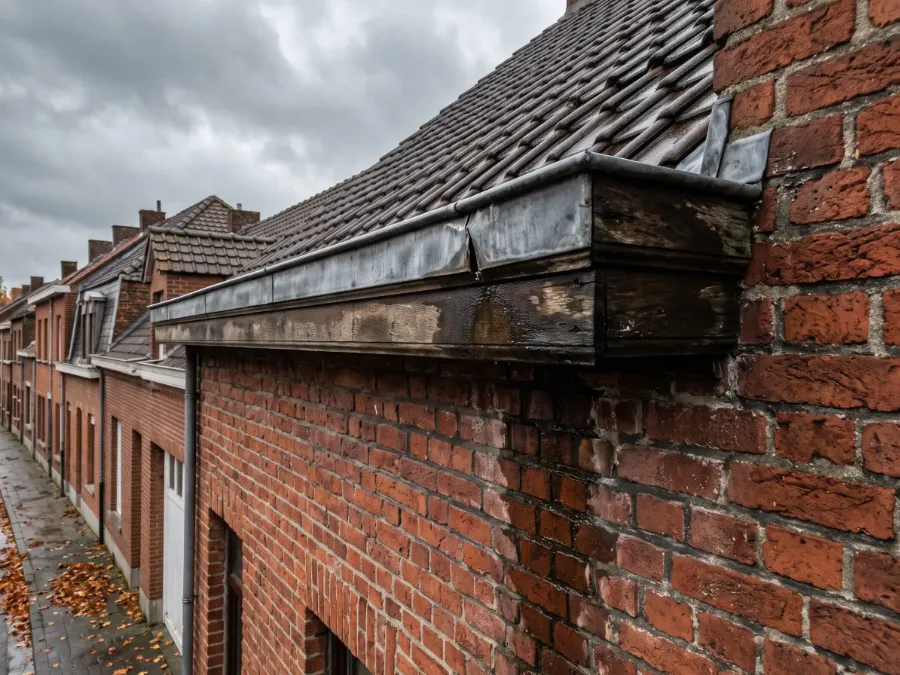
In Belgium, the corniche (kroonlijst in Dutch) is the boxed structure that runs along the edge of the roof on the street or garden side and carries the gutter. On many brick houses it is built in timber and lined with zinc: the zinc forms the channel that collects the water, the timber acts as support and finish. When either one gives way, the water no longer heads for the downpipe.
The signs can be read from the pavement or the garden:
- a streak or a darker band on the brick, just below the gutter, that stays damp long after the rain;
- moss or a green film on the top courses of brick;
- paint flaking off the timber, a board that swells or splits;
- water falling in a curtain between the gutter and the facade instead of going down the downpipe;
- in winter, icicles hanging from the edge of the gutter.
Indoors, the leak shows later: wallpaper peeling at the top of a front wall, a stain in the corner of the top-floor ceiling, a cellar smell in a bedroom under the roof. By then, water has been working its way through the masonry for quite some time.
Look without climbing: where and when the water escapes
A sound diagnosis starts at ground level, on a day of proper rain. Take binoculars if you have some, walk round the house and note three things: exactly where the water comes out, when it comes out (from the first drops, or only in a heavy downpour) and which way the wind was blowing that day.
Never lean a ladder against a box gutter, not even for a quick look. The timber may be weaker than it seems, and a zinc lining buckles under the weight of a ladder. Checking at height is the tradesman’s job, from a mobile scaffold tower or a cherry picker depending on access.
A few clues already point the way:
- a leak in one place, always the same: a split soldered seam, a holed connecting piece, or the joint with the neighbour’s gutter;
- leaks in several places, even in light rain: zinc worn along its whole length;
- water spilling over the front, especially in autumn: a plug of leaves or a choked downpipe, which first calls for clearing out the gutter and the downpipes;
- water escaping near the downpipe: a loose or cracked outlet, the piece that links the bottom of the gutter to the pipe.
The most common causes
The seam that cracks
Through the seasons, zinc lengthens and then shortens again. Over a long run laid without an expansion joint, that movement eventually splits the soldered seams, often after a winter of very changeable temperatures. The crack is fine and invisible from the ground, but it lets water through every time it rains.
Zinc worn through
A zinc lining wears slowly. It thins where water sits: under a heap of leaves or moss that stays wet, or in a section that slopes the wrong way. It can also corrode from underneath when it rests on damp, poorly ventilated timber. Once the metal is pitted in several places, soldering one hole simply means waiting for the next one.
The outlet and the downpipe
The joint between the gutter and the downpipe takes a lot of strain. A sleeve that has come loose, a missing leaf guard that lets leaves slide into the pipe, a blocked bend at the foot of the wall: the water backs up and looks for another way out.
Rotting timber
When water has been running under the zinc for a long time, the timber support soaks it up. It rots, the lining sags, the fall reverses and even more water sits there. That is the cycle you have to break. If the rafter ends or the wall plate are affected, the repair goes beyond zinc work and calls for a proper check of the roof timbers.
The joint with the house next door
In a terrace of houses, the box gutters run one into the next. Sometimes the leak sits exactly on the boundary between two properties, where two gutters from different periods meet. A lasting repair then means talking to the neighbour, so that the joint can be redone on both sides.
Patch it locally or fit a new zinc lining?
The choice does not depend on the age of the gutter, but on the condition of the metal and the timber.
A local repair makes sense when the zinc is sound along its whole length, the fault is isolated and the timber is dry. We clean, re-solder the seam with tin, replace the outlet or a short section, then run a water test before leaving.
A new zinc lining is needed when the metal is thin or pitted in several places, when repairs keep piling up, or when the fall is out. The zinc is then formed to measure, with expansion joints in the right places, and laid on a support that has been put right first. Rotten boards are replaced before anything else, otherwise the new zinc sags along with them.
Some firms suggest lining the inside of the gutter with a synthetic membrane. It is quick, but it does not fix damaged timber or a reversed fall, and the joint with the remaining zinc pieces is not always straightforward. It is an option worth discussing, not one that should be pushed on you.
Be wary, on the other hand, of sealant, cold bitumen or adhesive tape sold as a permanent repair. They buy a few weeks, long enough to wait for a dry day to solder. They also hide the crack, which makes the next job harder.
What waiting costs you
A leaking box gutter does not get worse all at once, and that is exactly what makes it treacherous. Water running down the facade saturates the brick at the top of the wall. At the first frost, that water bursts the face of the bricks and eats into the joints. Our guide on brick facades and driving rain shows how that damp ends up coming through the wall.
Higher up, the gutter timber and the ends of the rafters stay wet for months. That is precisely the ground that fungi look for. And when the stain finally appears in the bedroom, the plaster often has to be redone on top of the gutter itself.
The price of a repair depends on the length involved, the state of the timber, the type of gutter (moulded cornice, boxed gutter, hanging gutter) and access: a narrow street or a tall facade calls for scaffolding or a cherry picker. Those are the points we note on site before putting a figure on the work.
Before winter: what you can do, and what to leave to a tradesman
On your side, without taking any risks:
- watch the facade in the rain and photograph the streaks, noting the date;
- check that the downpipe drains properly at the foot of the wall and that the inspection chamber is not blocked;
- look for marks indoors, even faint ones, in the rooms under the roof;
- if a tree overhangs the roof, plan to have it cut back.
On the tradesman’s side, a box gutter is best checked in autumn, once the leaves have fallen, at the same time as the gutters are cleared. That is also the period we recommend in our guide on the right time to have gutters cleared. If water appears indoors with no obvious trace on the facade, it is better to start with methodical leak detection: the gutter is not always the culprit.
Frequently asked questions
Can a zinc box gutter be repaired with sealant?
For a few weeks, while you wait for a dry day, yes. Sealant does not follow the movement of the zinc: the crack opens up again, and the product hides the fault at the next inspection.
Does the whole gutter need redoing if only one seam leaks?
No, if the zinc is sound elsewhere and the timber is dry. A seam re-soldered with tin, followed by a water test, is enough in that case.
Why does my box gutter only leak in winter?
Cold makes the zinc contract and reopens tired seams. Ice can also block the outlet and push water back towards a joint that stays dry the rest of the year.
Can a leaking box gutter damage the roof structure?
Yes, through the ends of the rafters and the timber that carries them on the wall. The longer the leak goes on, the more likely it is that this timber will need treating or replacing along with the zinc work.