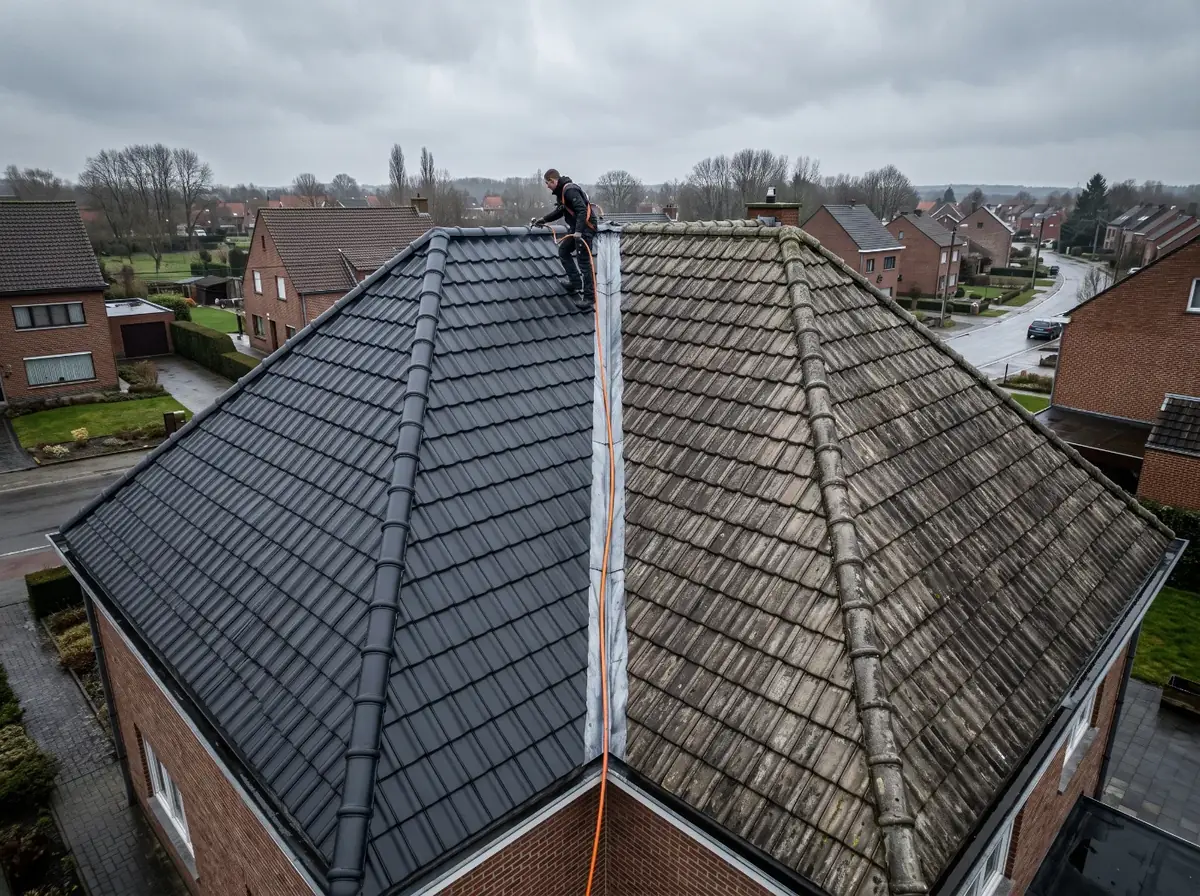
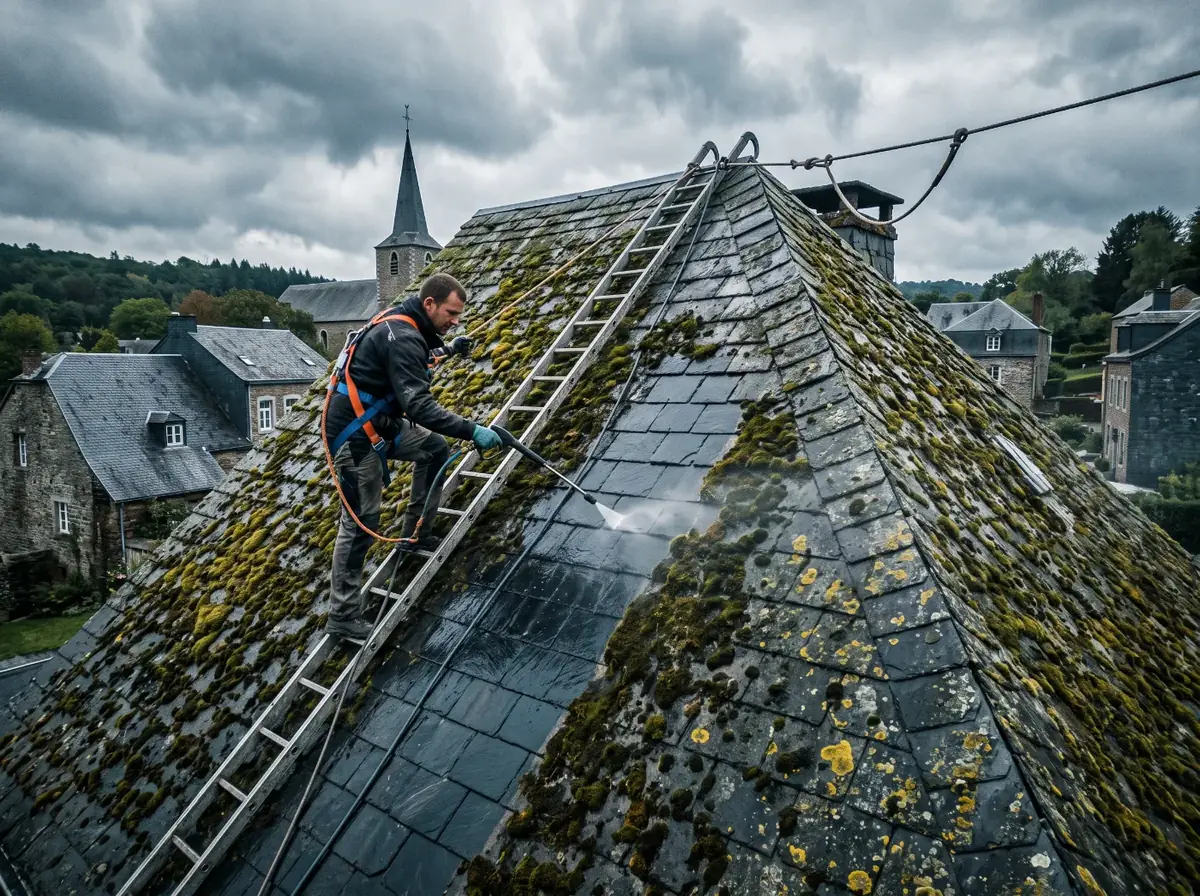
A Belgian roof turns green again. It is not a fault in the workmanship and it is not bad luck: it is the direct result of an oceanic climate that brings between 800 and 900 mm of rain a year, spread over close to two hundred days.
Three factors, always the same
Orientation first. A north-facing pitch gets little direct sun: it dries slowly, stays damp for days after rain, and gives moss exactly what it wants. On the same house, the south-facing pitch can stay clean ten years longer.
Then porosity. A 1970s concrete tile has lost part of its engobe. It soaks up water like a sponge and turns into a growing medium. Natural slate, denser, holds up considerably better — until lichen gets a grip on it anyway.
And finally the surroundings. An oak eight metres away, a conifer hedge, a garden wall that blocks the wind: anything that holds damp and drops organic matter speeds the process up. In Waterloo, in Lasne or in Rixensart, that factor counts for more than the age of the roof.
Why this is not just a question of looks
A carpet of moss holds water against the roof tile. In winter that water freezes. As it freezes it expands and lifts the tile very slightly, or blows its surface apart. Repeated over five or six winters, that eventually opens a way through to the battens, and then to the roof timbers.
At the same time the moss that comes loose drops into the gutter and clogs it. A blocked gutter overflows against the facade, which soaks up water in turn. The problem starts at the top and gets paid for at the bottom.
What really slows the moss coming back
- A low-pressure clean, never a high-pressure lance held ten centimetres away: it strips the engobe and leaves the tile more porous than before.
- A fungicidal treatment left to work, with the contact time respected.
- An impregnating water repellent, which makes water bead off and starves moss of the constant damp it needs.
- A trim of the branches overhanging the roof, where that is possible.
- Gutters cleared once a year, twice if there are trees nearby.
How often to step in
On a sound roof treated with a decent water-repellent, a cycle of eight to ten years is realistic. On a very porous tile or a heavily shaded north-facing slope, count on five to seven years instead. An honest contractor gives you that range before the job, not after.